First of three on how the framing of a shipping story decides what the public does with it.
Why a missile gets more coverage and less attention
Not all attention is worth having.
That is probably obvious enough that you're wondering why I'm writing it down. But there is a version of this that isn't obvious; it shows up when you stop counting coverage and start watching what people actually do after they read it.
The Maritime Attention Index measures four things every day: what people search for, what they look up on Wikipedia, what they post about, and how much the press publishes. Three of those are the public doing something. One is the press doing something. Over the last six years the index has recorded 113 maritime incidents in enough detail to ask a question — what kind of story about our industry actually makes people go and find out more?
The answer isn't the kind of incident. Fires, collisions, groundings and seizures all behave much the same. What predicts the public's response is how the coverage frames the story.
And one frame stands out for failing to get people interested in the maritime sector.
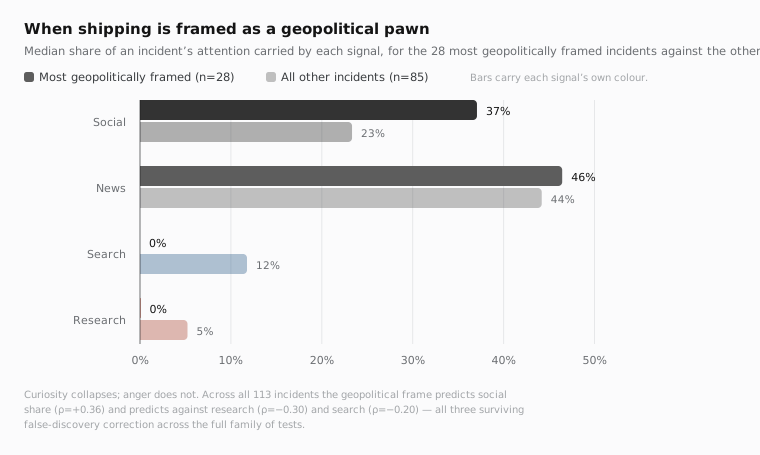
When shipping is written about as a geopolitical pawn — a pressure point between states, a proxy for somebody else's conflict — social media lights up and everything else goes dark. Across all 113 incidents that framing predicts a higher share of attention on social (ρ=+0.36) and predicts against both research (ρ=−0.30) and search (ρ=−0.20). All three hold after correcting for the other variables we tested.
The extremes make the point even better than the statistics do.
The Houthi missile that hit a container ship in the Gulf of Aden in August 2024 was 96% geopolitically framed. It produced news coverage and precisely nothing else — no search, no Wikipedia, not even social. Iran's seizure of a container ship in the Strait of Hormuz that April pushed the index to 167, well above normal, on news and social alone. Search: zero. Research: zero. Ukraine's strike on the Crimean shipyard scored a perfect 1.00 on the geopolitical frame.
People took a side. Nobody took an interest.
Compare that with the Ever Given, where nearly half the attention came from Wikipedia — people going away to read about container ships, canals and how any of this works. Same industry, completely different public behaviour.
From a crisis communications standpoint, don't focus on the coverage count, focus on the frame. This indicator will tell you far more about how the public is engaging with your incident.
Unfortunately, once your incident has been absorbed into a bigger conflict, the effectiveness of your communication deteriorates. Your audiences have already decided what the story means; your ship is a detail in somebody else's argument.
If you're the operator, this changes what a good outcome looks like. You will not win a geopolitically framed story on facts, and you will exhaust your team trying. What you can still do is protect the narrow band of ground that stays yours — your crew, your response, your conduct — and refuse the invitation to argue about the geopolitics.
So watch the frame, not the clipping count.