Second of three on how the framing of a shipping story decides what the public does with it.
Drama sends people to Google. It doesn't send them to the library.
Everybody in maritime communications wants the human story.
Find the crew member. Find the rescue. Find the moment the thing went wrong and the people it went wrong to. The received wisdom is that the human angle is what makes shipping legible to an audience that otherwise doesn't care, and I have given that advice myself more times than I can count.
The Maritime Attention Index says it half works.
Across 113 incidents over six years, the incidents whose coverage leans hardest on human drama produce a lot more searching. Median search share more than triples, from 4.2% of an incident's attention to 14.3%.
And they produce exactly no additional reading.
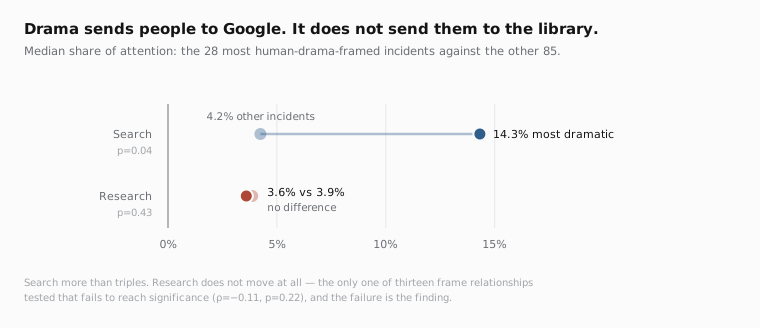
Research share for the most dramatic quarter of incidents is 3.6%. For everything else it is 3.9%. Effectively no difference at all — and out of thirteen frame relationships tested across the catalogue, this is the only one that fails to reach significance (ρ=−0.11, p=0.22).
The failure is the finding.
Look at what people actually did. When a bulk carrier exploded near Baltimore Harbor in August 2025, two thirds of the attention it generated was search and 7% was research. The container ship fire at the Port of Los Angeles later that year: 28% search, zero research. The Ever Forward refloating scored 0.99 on human drama, the highest in the catalogue — 22% search, zero research. The 2023 grounding in the Suez Canal, 0.91 on drama: 17% search, 6% research.
People Googled the ship, but they didn't go on to research anything more about shipping.
That distinction matters more than it looks. A search spike is somebody typing the vessel's name into a box because they saw a picture and wanted to know what happened. It ends when they find out. A Wikipedia lookup is somebody who has decided the category is interesting — container ships, tankers, how any of this works — and those are the people who still know something about your industry a year later.
Drama buys you the first. It does not buy you the second.
However, don't read this as an argument against the human story. Search is real attention and it is worth having. When your incident is being searched for, people are actively looking for information rather than passively receiving it, which is the one moment in a crisis when what you publish can actually reach somebody who wants it. That window is genuinely valuable and it is short.
The mistake is what we tell ourselves afterwards.
The industry has spent years complaining that the public doesn't understand shipping. Dramatic incidents generate spikes of curiosity about that ship on that day, but not the lasting impact we'd like.
So use the drama for what it's actually good for. When the human story breaks, that is your moment to be findable — make sure the thing people land on when they search answers the question they came with, because they will not come back and ask a second one.
Just don't tell your board it bought you public understanding, we'll need to rely on other stories for that.