Last of three on how the framing of a shipping story decides what the public does with it.
The industry is at its most visible when it has the least to say
Shipping is very rarely the subject of its own sentences.
Vessels are seized, struck, boarded, grounded, detained, blockaded and sunk. Read a month of maritime coverage and the industry appears almost entirely in the object position — the thing being acted upon rather than the thing acting.
The Maritime Attention Index scores every article it reads for exactly that, and across 113 incidents the median is 58% "entirely acted upon". Which is worth sitting with for a second, because it is a description of how an entire industry appears in public.
It is also the single cleanest predictor of whether anybody learns anything.
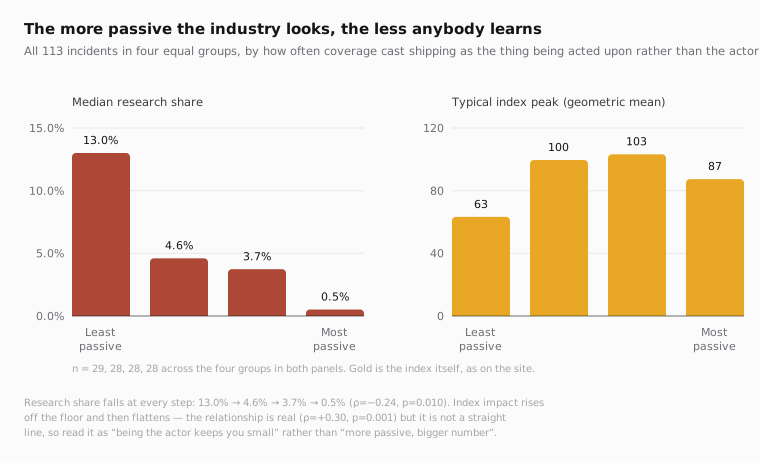
Split all the incidents in the index into four equal groups by how passively the coverage cast the industry, and research share falls at every single step: 13.0%, then 4.6%, then 3.7%, then 0.5%. The most passive 25% of incidents produce essentially no measurable public learning at all (ρ=−0.24, p=0.010).
Meanwhile the index itself goes the other way. The typical peak rises from 63 in the least passive group to around 100 in the middle — the relationship is real (ρ=+0.30, p=0.001), though it isn't a straight line and flattens out at the top. Read it as "being the actor keeps you small" rather than "the more passive you look, the bigger the number".
But the shape of it is clear enough. The industry is at its most visible in exactly the moments when the public is learning least from it.
The individual records are stark. The abduction of a Greek tanker's crew in Cameroon — scored a perfect 1.00 for passivity — produced 98% of its attention on social media and zero research. Iran's seizure of a container ship in the Strait of Hormuz, 0.98 passive, pushed the index to 167 and taught nobody anything.
Now look at the other end. The LNG carriers waiting off European ports scored zero for passivity — ships choosing to wait, an industry doing something — and 86% research. Matson choosing to ban EVs after a run of vessel fires, 0% passive, a third research.
There is a comms lesson in this.
The obvious reading is "make sure your company is the actor in the story". Sure. Everyone already knows that, and in a seizure or a missile strike it isn't available to you — you cannot narrate your way out of the object position when a state actor has physically taken your ship.
The more useful reading is about what you expect the coverage to achieve. A big index reading during a seizure is not evidence that anybody now understands your business better. It is evidence that a lot of people watched something happen to you.
If your reporting to the board treats those as the same thing, you will consistently overstate what your biggest weeks achieved and understate what your quiet ones did.
So run two lines in your reporting, not one. How much attention did the incident get, and what did the audience do with it — did they go looking, or did they just watch?
Because an industry that only ever appears in the object position ends up with exactly the public standing you'd predict. Widely seen. Rarely understood. And every year, a little more surprised about it than it has any right to be.